Ikibazo: Urugero rw'Ameza
Martingale ya $10 ku meza afise urugero rwa $500. Ivunika incuro zingahe, ihomba angahe iyo ivunitse, kandi kwongereza urugero vyoba bifasha?
Ibihombo bitandatu bikurikirana biravuna: 1,8% kuri buri muzingi, hafi 60% vy'ibihe vy'ugukina vy'ukuzunguruka 100. Iryo vunika ritwara $630. Kwongereza urugero gushika $5.000 bituma ivunika riba gake (0,25% kuri buri muzingi) kandi rikaba rinini ($5.110). Igihombo citezwe kuri buri dorari riteze ni 2,70% ku rugero urwo ari rwo rwose.
Ikibazo
Assume independent spinsimibareUkuzunguruka kwigengaUkuzunguruka kwose kugira ugushoboka kumwe n'ivyabaye kera vyose. Ni co gishingiro c'ibiharuro vyose vyo kuri uru rubuga.Soma vyose → and standard single-zerouruzigaZeruAkazu kamwe k'icatsi kibisi kadapfukwa n'itego rya rimwe kuri rimwe, ry'umurwi canke ry'inkingi; ni yo soko y'inyungu ya kazino. Kandi bita: zeru imwe, 0.Soma vyose → payoutsamaheraIrihaIvyo itego ritsinze rizana, bivugwa nka “X kuri 1” hiyongereyeko amahera y'itego asubizwa.Soma vyose →, with enough bankrollamaheraAmahera yo gukinishaAmahera yose yashizwe ku ruhande yo gukina. Gucunga amahera yo gukinisha ni uguhitamwo ayo ushobora gushira mu kaga kuri buri tego no kuri buri gihe c'ugukina.Soma vyose → to fund each permitted stake. A player bets $10 on reditegoGitukuraItego rya rimwe kuri rimwe ku nomero 18 zitukura. Mu gifaransa: rouge.Soma vyose → and doubles after each loss, resetting after a win. The table maximum is $500. (a) How many consecutive losses break the progressioningendo yo gutegaIyongerekanaItegeko ryose rihindura amahera y'itego hisunzwe ivyavuyemwo vyabanje. Iyongerekana rihakana riyongereza inyuma y'ibihombo, iryemeza inyuma y'itsinzi.Soma vyose →? (b) What is the probabilityimibareUgushobokaUgushoboka kw'ivyavuyemwo, kuva kuri 0 gushika kuri 1 canke 0% gushika 100%. Inomero imwe: 1/37 = 2,70%.Soma vyose → per cycle? (c) What is lost at the break? (d) How does a $5,000 limit change the answers? (e) Does any limit make the system profitable?
Inyishu (a)–(c)
Amahera y'itego: 10, 20, 40, 80, 160, 320. Irya indwi ryoba 640 > 500, ku buryo ibihombo bitandatu bivuna. (b) p(igihombo) = 19/37 ku gitukura; (19/37)⁶ = 0,0183, hafi 1,8% kuri buri muzingi. Umuzingi umara hafi ukuzunguruka kubiri ku mpuzandengo, ku buryo igihe c'ugukina c'ukuzunguruka 100 gifise hafi imizingi 50 kandi p(nibura ivunika rimwe) ≈ 1 − 0,9817⁵⁰ ≈ 60%. (c) 10 + 20 + 40 + 80 + 160 + 320 = $630, ari vyo ibiceamaheraIgiceAmahera y'itego y'ishingiro uburyo canke umukinyi akoresha. Iyongerekana ridondorwa mu bice kugira ngo rikore ku meza ayo ari yo yose.Soma vyose → 63 vy'intango, ugereranije na $10 umuzingi wariko urondera gutsinda.
Inyishu (d)
At $5,000: stakes to 2,560 are allowed; the tenth stake, 5,120, is refused. Nine losses break it: (19/37)⁹ ≈ 0.25% per cycle, about 11% of 100-spin sessions. Loss at the break: 10 + 20 + … + 2,560 = $5,110. The player has bought a rarer catastrophe at the price of a larger one. Over many sessions the expected cost of breaks is p × loss ≈ 0.0183 × 630 = $11.5 per cycle at the $500 limit and 0.0025 × 5,110 = $12.8 at $5,000; each is the expected contribution from failed cycles. Subtract the expected profit from successful cycles, $10 × (1 − p), to obtain total expected lossimibareIgihombo citezweAgaciro kitezwe gakubwe n'amahera yose yateze; ni amahera y'impuzandengo atakara mu gihe c'ugukina canke mu gihe runaka.Soma vyose → per cycle: about $1.74 and $2.71 respectively.
Inyishu (e)
With a finite limit and a well-defined stopping rule, expected loss equals expected turnoveramaheraIgiteranyo c'amategoIgiteranyo c'amahera yose yateze mu gihe c'ugukina canke mu kiringo, harimwo n'ivyatsinzwe vyongeye gutegwa. Kandi bita: handle, action.Soma vyose → divided by 37. Changing the limit can change turnover substantially. For the 100-spin examples below, the player resets to $10 after either a win or a failed progression, and has enough money to place every bet. These are exact model expectations, not a simulation. The imaginary unlimited-bankroll, unlimited-stake Martingaleingendo yo gutegaMartingaleIyongerekana rikuba kabiri itego inyuma y'igihombo cose. Raba igice c'Ingendo zo gutega umenye ivyo bukora n'ivyo budakora.Soma vyose → is different: a single cycle eventually wins $10 with probability 1, but its expected turnover is infinite. The finite-expectation identity cannot be applied to that unbounded stopping problem. Real bankrolls and tables cannot implement it.
Ameza abiri nyayo
Akarorero ka Thorp ni ameza ya $1 afise urugero rwo hejuru rwa $1.000, aho umukinyi yizera gutsinda $30 y'imfungurwa z'umugoroba idorari rimwe rimwe. Amahera y'itego 1, 2, 4 … 512 yemera amatego cumi, ku buryo ibihombo cumi bikurikirana bivuna iyongerekana: incuro imwe mu mizingi 785 ku ruziga rwa ruleti y'i Buraya (incuro imwe muri 613 ku ruziga rwa ruleti y'Amerika), bigatwara $1.023. Imizingi mirongo itatu yose iraroranirwa incuro 96,2%. Izindi 3,8% zihomba hafi $1.000, kandi ivyavuyemwo ku mpuzandengo vy'umugoroba ni −$9,17, ari vyo neza neza 1/37 ya $339 imizingi mirongo itatu iteza ku mpuzandengo. Ameza ya $5 afise urugero rwo hejuru rwa $2.000 nta co atandukaniyeko: amahera y'itego gushika $1.280 yemera amatego icenda, kandi ivunika riza incuro imwe mu mizingi 403 ku ruziga rwa ruleti y'i Buraya (incuro imwe muri 323 ku ruziga rwa ruleti y'Amerika) rigatwara $2.555.
Umukinyi w'umutunzi
The table maximum is only one constraint. The player may run out of money before reaching it. A simulation must state whether it stops, resets to the base stake or bets the remaining balance when the next double is unaffordable. Those choices change session probabilities, so results from one rule cannot describe every Martingale strategy.
Icigwa
A higher limit permits rarer but larger failed progressions. It does not remove the negative expectation of each standard bet, and it may increase the amount wagered. Compare the total exposure and stopping rule as well as the chance of a short winning cycle.
Ingingo y'imibare
Ibibazo
Agufasha kurokoka gushika ku rugero ruri hejuru, aho ivunika riba gake kandi rikaba rinini. Igihombo citezwe kuri buri dorari ntigihinduka.
Amahera y'itego 10, 30, 70, 150, 310: urugero rwa $500 rushikwako inyuma y'ibihombo bitanu, kandi ivunika ritwara $570. Ni 2,70% nyene.
A maximum limits the payout exposure accepted on a bet. The operator sets the actual limits; their existence does not create roulette’s house edgeimibareInyungu ya kazinoIgice c'amahera y'itego kazino igumana ku mpuzandengo: 2,70% muri ruleti y'i Buraya.Soma vyose →.
Twinezwe n'Imibare
Banza ubigerageze wewe nyene. Inyishu yose irapfutse; yugurure igihe witeguye.
A Martingaleingendo yo gutegaMartingaleIyongerekana rikuba kabiri itego inyuma y'igihombo cose. Raba igice c'Ingendo zo gutega umenye ivyo bukora n'ivyo budakora.Soma vyose → starts at $100 on reditegoGitukuraItego rya rimwe kuri rimwe ku nomero 18 zitukura. Mu gifaransa: rouge.Soma vyose → and allows itself at most n bets a cycle: after n losses in a row it gives up and starts again. Write the average result of one cycle as a formula in n, and work it out for 5, 6 and 7 bets on a European wheel. Assume independent uniform single-zerouruzigaZeruAkazu kamwe k'icatsi kibisi kadapfukwa n'itego rya rimwe kuri rimwe, ry'umurwi canke ry'inkingi; ni yo soko y'inyungu ya kazino. Kandi bita: zeru imwe, 0.Soma vyose → results and sufficient funds for every permitted stake.
Erekana inyishu
Inyishu Impuzandengo ni 100 × (1 − (38/37)ⁿ): −$14,26 ku matego 5, −$17,35 kuri 6 na −$20,52 kuri 7. Kwemera amatego menshi bituma umuzingi w'impuzandengo urushiriza kuba mubi, si mwiza.
A cycle wins $100 unless all n bets lose, which happens with chance qⁿ, where q = 19/37. When they all lose, the stakes 100, 200 … 100 × 2ⁿ⁻¹ add up to 100 × (2ⁿ − 1). So the average is 100 × (1 − qⁿ) − 100 × (2ⁿ − 1) × qⁿ = 100 × (1 − (2q)ⁿ).
Here 2q = 38/37, a little more than 1, so (2q)ⁿ grows with n and the average falls: n = 5 gives 1.1426 and −$14.26; n = 6 gives 1.1735 and −$17.35; n = 7 gives 1.2052 and −$20.52. A longer ladder loses less often, in 3.6%, 1.8% and 0.9% of cycles, but each loss is twice as large, and more money crosses the table each cycle, at 2.70% of every bet.
On an American wheel 2q = 40/38 and the figures are −$29.24, −$36.04 and −$43.20. In a game with no zero 2q = 1, and every cycle averages exactly zero however long the ladder.
“Martingale nini” ikuba kabiri amahera y'itego inyuma y'igihombo ikongerako igiceamaheraIgiceAmahera y'itego y'ishingiro uburyo canke umukinyi akoresha. Iyongerekana ridondorwa mu bice kugira ngo rikore ku meza ayo ari yo yose.Soma vyose → kimwe, ku buryo amahera y'itego aba 1, 3, 7, 15, 31 … Uri imbere angahe iyo itsinzi rya mbere rije ku tego rya 1, rya 2, rya 3 canke rya k? Ku gice ca $10 n'urugero runini rwa $500, umuzingi umeneka kangahe, kandi umuzingi utwara iki ku mpuzandengo?
Erekana inyishu
Inyishu Itsinzi ku tego rya k rigusiga uri imbere n'ibice k: +1, +2, +3 n'ibindi. Kuri $10 na $500 umuzingi umeneka inyuma y'ibihombo bitanu, 3,57% vy'imizingi, kuri −$570. Ku mpuzandengo umuzingi uhomba $2,32 muri $85,73 yateze: 2,70%.
The kth stake is 2ᵏ − 1 units: 1, 3, 7, 15, 31. The first k − 1 stakes add up to 2ᵏ − 2 − (k − 1) = 2ᵏ − k − 1. A win on the kth bet pays 2ᵏ − 1, so the cycle ends (2ᵏ − 1) − (2ᵏ − k − 1) = k units up: one extra unit for every loss before the win.
At least $570 is needed to fund all five stakes in a fresh cycle. At $10 a unit the stakes are $10, $30, $70, $150 and $310; the next, $630, is over the $500 maximum. Five losses in a row, (19/37)⁵ = 3.57%, cost 10 + 30 + 70 + 150 + 310 = $570.
Average: the wins bring in $10 × k with chance (19/37)ᵏ⁻¹ × 18/37 for k = 1 to 5, and the break takes $570 with chance 3.57%; together −$2.32. The money staked averages $85.73 a cycle, and 2.32/85.73 = 2.70%. The ordinary Martingale at the same table breaks after six losses, 1.83% of cycles, for −$630, and loses $1.74 out of $64.20 staked: 2.70% again.
Umukinyi ateganya Martingale kuri gitukura n'itego rya mbere rya $1 ku meza afise urugero rwa $1.000, ku buryo amatego cumi ashoboka: $1, $2, $4 n'ibindi gushika $512. Umuzingi uhomba ayo cumi yose kangahe, bifata igihe kingana iki ku mpuzandengo, kandi umugoroba w'amatego 200 urangira gutyo kangahe?
Erekana inyishu
Inyishu Umuzingi uhomba yose cumi nka rimwe muri 784, ivyo bigatwara $1.023. Ivyo ni nka matego 1.600 ku mpuzandengo, kandi umugoroba w'amatego 200 ushikira urwo rukuta nka 11% vy'incuro. Umuzingi uracahomba $0,31 ku mpuzandengo muri $11,31 yateze: 2,70%.
Itego kuri gitukura rihomba ku gushoboka kwa 19/37, zeru irimwo. Cumi bikurikirana: (19/37)¹⁰ ≈ 0,00128, nka 1 muri 784. Amahera y'itego 1 + 2 + 4 + … + 512 ateranirizwa akaba $1.023.
Umuzingi ufata amatego 2,05 ku mpuzandengo, ku buryo imizingi 784 ifata nka matego 1.600. Uharuye ukuzunguruka ku kundi, umurongo w'ibihombo cumi uboneka ahantu mu matego 200 11,3% vy'incuro.
Hagati y'ivyago, umukinyi atsinda $1 kuri buri muzingi: nka $783 imbere y'umuzingi mubi, hanyuma −$1.023, nka −$240 mu gihe cose. Kuri buri muzingi: 1 × (1 − 0,00128) − 1.023 × 0,00128 ≈ −$0,31. Amahera yateze kuri buri muzingi: 1 + 2 × (19/37) + 4 × (19/37)² + … + 512 × (19/37)⁹ ≈ $11,31. Na −0,31/11,31 = −2,70%.
Gereranya n'itego rya mbere rya $10 ku rugero rwa $500, amatego atandatu: urukuta ruza rimwe mu mizingi 55, kandi umugoroba w'amatego 200 uruhura na rwo 84% vy'incuro. Urugero rwo hejuru rutuma ugusenyuka kuba gake kandi kunini, si uguhendutse.
Agakuru ko gutwenga
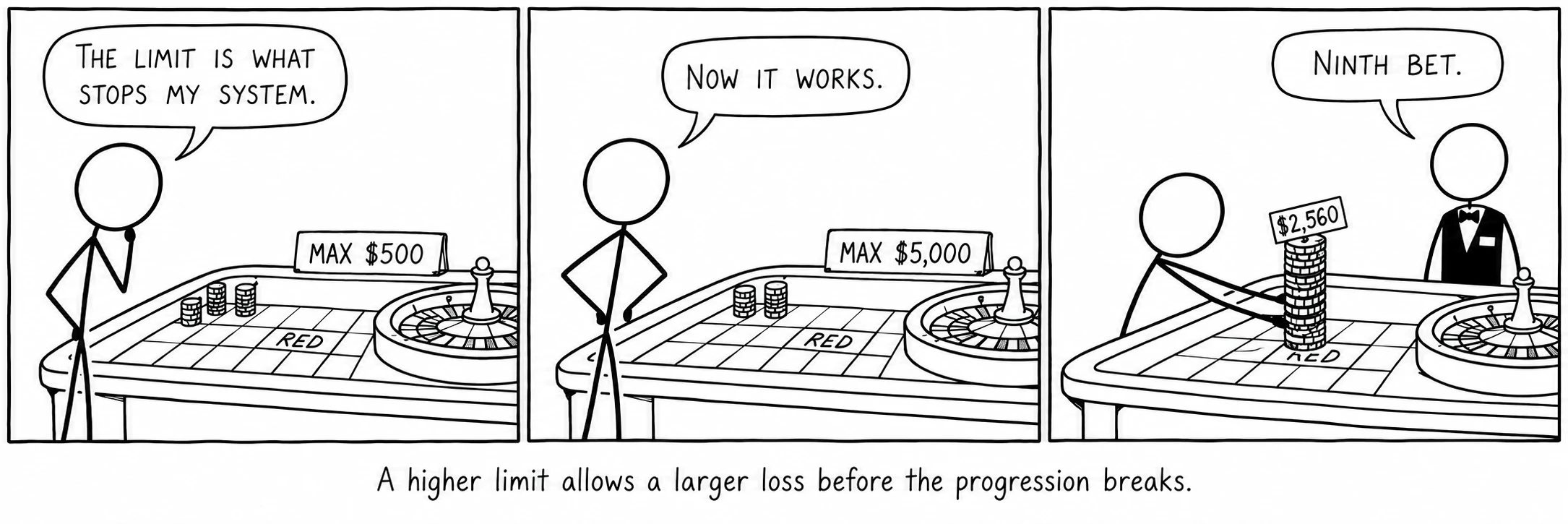
Gake kandi binini, ku rugero urwo ari rwo rwose. Igikubo ntigihinduka.
Aho Twakuye
- Ethier, S. N. The Doctrine of Chances: Probabilistic Aspects of Gambling.
- Thorp, E. O. “Optimal gambling systems for favorable games.”
- Thorp, E. O. The Mathematics of Gambling.
- Epstein, R. A. The Theory of Gambling and Statistical Logic, 2nd ed.