Ingingo ya Kelly na Ruleti
Igipimo ca Kelly kibwira umutezi afise inyungu amahera akwiye gutega. Kuri ruleti gitanga inyishu itomoye: nta na kimwe.
Amahera y'itego ya Kelly = inyungu / igipimo c'iriha. Iyo inyungu iri munsi ya zeru, iyo formule itanga igice kiri munsi ya zeru, bisobanura ngo ntutege. Ico gipimo kiracafasha gutahura igituma abakinyi bakoresha ukubogama kw'uruziga bategeye ukwo bategeye, n'igituma abandi bose bakwiye kugera amatego ku ngengo y'amahera yabo.
Igipimo
John Kelly (1956) asked how a gambler with a known edge should size bets to maximize long-run growth of the bankrollamaheraAmahera yo gukinishaAmahera yose yashizwe ku ruhande yo gukina. Gucunga amahera yo gukinisha ni uguhitamwo ayo ushobora gushira mu kaga kuri buri tego no kuri buri gihe c'ugukina.Soma vyose →. The answer, for a bet paying b to 1 with win probabilityimibareUgushobokaUgushoboka kw'ivyavuyemwo, kuva kuri 0 gushika kuri 1 canke 0% gushika 100%. Inomero imwe: 1/37 = 2,70%.Soma vyose → p and loss probability q = 1 − p, is to stake the fraction f* = (bp − q) / b of the bankroll. Positive f* means bet that fraction; zero or negative means do not bet. Kelly worked at Bell Labs, and his paper, “A new interpretation of information rate”, set the problem in Claude Shannon’s theory of information: a gambler who gets tips over a noisy line, at fair odds, can grow the bankroll at best at the rate the line carries information. This is a growth objective under a probability model, not a promise to finish ahead after a particular number of bets. A spending limit, finite deadline or payoutamaheraIrihaIvyo itego ritsinze rizana, bivugwa nka “X kuri 1” hiyongereyeko amahera y'itego asubizwa.Soma vyose → cap changes the decision problem.

Gutega kwa Kelly muri ruleti
For reditegoGitukuraItego rya rimwe kuri rimwe ku nomero 18 zitukura. Mu gifaransa: rouge.Soma vyose →: b = 1, p = 18/37, q = 19/37; f* = (18/37 − 19/37)/1 = −1/37. For a straight upitegoStraight upInomero imwe gusa, iriha 35:1.Soma vyose →: b = 35, p = 1/37, q = 36/37; f* = (35/37 − 36/37)/35 = −1/1295. Every standard bet gives a negative Kelly fraction, because every bet has a negative edge, and the growth-optimal stake is zero. Kelly betting on roulette is a formal way of saying what the house-edge page says: no positive stake maximizes expected logarithmic growth when the bet has negative expectation. A particular session can still end in profit. La partageitegekoLa partageItegeko ry'Ubufaransa: iyo zeru ije, igice c'amahera y'itego rya rimwe kuri rimwe kirasubizwa. Rigabanya inyungu ya kazino kuri ayo matego gushika kuri 1,35%.Soma vyose → needs a separate three-outcome calculation: a win, a full loss or a half-loss on zerouruzigaZeruAkazu kamwe k'icatsi kibisi kadapfukwa n'itego rya rimwe kuri rimwe, ry'umurwi canke ry'inkingi; ni yo soko y'inyungu ya kazino. Kandi bita: zeru imwe, 0.Soma vyose →. Its expected log growth also falls as the stake increases from zero.
Aho Kelly yakoreshejwe koko
Suppose a pocketibikoreshoAkazuKimwe mu bibanza 37 bifise inomero kuri rotor. Kandi bita: slot, cup.Soma vyose → really has a stable, known probability of 1 in 30 and pays 35 to 1. The Kelly fraction is 0.57%: about $57 from a $10,000 bankroll. Under independent spinsimibareUkuzunguruka kwigengaUkuzunguruka kwose kugira ugushoboka kumwe n'ivyabaye kera vyose. Ni co gishingiro c'ibiharuro vyose vyo kuri uru rubuga.Soma vyose → and exact fractional staking, the geometric growth factor over 1,000 spins is about 1.7. Expected bankroll grows faster because rare large wins pull up the average. These are model calculations, not evidence that any named historical player used Kelly or achieved this result.
Ivyisanzwe n'ivyo ku mpuzandengo
The gap between the typical bankroll and the average one is wide. Take a pocket that hits 1 time in 25, a hypothetical edge of 44% per unitamaheraIgiceAmahera y'itego y'ishingiro uburyo canke umukinyi akoresha. Iyongerekana ridondorwa mu bice kugira ngo rikore ku meza ayo ari yo yose.Soma vyose → staked. Kelly stakes 1.26% of the bankroll on it. After 1,000 spins the typical bankroll has grown about 11.5 times, while the average, pulled up by a few very lucky runs, has grown about 249 times. Betting more than Kelly raises the average and lowers the typical result: at twice the Kelly stake the typical bankroll only doubles, and by two and a half times the Kelly stake it shrinks, although every bet still carries a 44% edge. In this example, half-Kelly retains about 78% of the expected log growth. This fraction depends on the probabilities and payout.
Iyo inyungu ari ikiharuro c'ukwiyumvira
Kelly uses the true probabilities, but a player usually has only estimates. Selecting the busiest pocket from a past record creates a selection problem: even a fair wheel has a busiest pocket. Its observed rate can overstate its future probability. Choosing the stake from that same record compounds the error. An independent follow-up sample helps test a proposed bias (see How to Detect Roulette Wheel Bias). Reducing the calculated fraction reduces exposure, but cannot turn a false edge into a real one.
Abantu bafise inyungu
Haghani and Dewey (2016) studied 61 participants given $25 and 30 minutes to bet on a simulated coin with a disclosed 60% chance of heads. The payout cap was $250; its value was revealed when a proposed winning bet would reach it. Their reported 21% success category included balances of at least $200, while the 28% “bust” category meant less than $2, not necessarily zero. Eighteen participants bet their entire balance on one flip. The uncapped Kelly fraction is 20%, but the cap and deadline change the optimization problem. The experiment illustrates how stake choices matter even with a known advantage; it does not establish one best strategy for every objective.
Ico wokoresha aho kuba ivyo
Utagira inyungu, kugera amatego ni ikibazo c'ingengo y'amahera, si ikibazo c'iyongerekana: amahera y'itego = ayo wemera gukoresha kuri buri kuzunguruka, akuwe ku ngengo y'amahera y'isaha n'umuvuduko w'ameza (urupapuro Gucunga Amahera yo Gukinisha Ruleti). Ico Kelly azanira umukinyi asanzwe ni ukutomoka kw'inyishu yiwe: zeru. Ivyo wese utega birenze zeru ni igiciro co gukina, wihitiyemwo, kitatunganijwe na formule iyo ari yo yose.
Ijambo ku gice ca Kelly no ku “gucunga amahera”
Betting a fixed percentage of the current bankroll is proportional staking: the stake rises after wins and falls after losses. Flat bettingingendo yo gutegaGutega amahera anganaGutega amahera angana kuri buri kuzunguruka. Ni urugero iyongerekana ryose rigereranywa na rwo.Soma vyose → instead keeps the cash stake fixed. Neither creates an edge on ordinary roulette. With infinitely divisible stakes and a fraction below 100%, proportional staking never reaches exactly zero in finitely many losses, but the balance can become arbitrarily small. Real table minimums can prevent further play much sooner. The growth-optimal fraction remains zero.
Ingingo y'imibare
Ibibazo
Only when the actual probabilities, payouts and conditions give a credible positive advantage. Standard bets on an unbiased wheel have no such advantage.
Using half the calculated fraction reduces exposure to errors in the estimated edge. The familiar three-quarters-growth rule is an approximation for small advantages, not a universal identity. It does not protect against an edge that does not exist.
Oya. Kelly atunganya iyongerekana iyo hari inyungu. Gucunga amahera yo gukinisha bigenzura ugukoresha iyo nta nyungu ihari.
Twinezwe n'Imibare
Banza ubigerageze wewe nyene. Inyishu yose irapfutse; yugurure igihe witeguye.
Suppose a hypothetical bet on one number has a known 44% edge under standard payoutsamaheraIrihaIvyo itego ritsinze rizana, bivugwa nka “X kuri 1” hiyongereyeko amahera y'itego asubizwa.Soma vyose → and independent spinsimibareUkuzunguruka kwigengaUkuzunguruka kwose kugira ugushoboka kumwe n'ivyabaye kera vyose. Ni co gishingiro c'ibiharuro vyose vyo kuri uru rubuga.Soma vyose →. Kelly gives a 1.26% bankrollamaheraAmahera yo gukinishaAmahera yose yashizwe ku ruhande yo gukina. Gucunga amahera yo gukinisha ni uguhitamwo ayo ushobora gushira mu kaga kuri buri tego no kuri buri gihe c'ugukina.Soma vyose → fraction. What if the same 44% edge came on one bet spread over five neighboring numbers?
Erekana inyishu
Inyishu Ico gihe Kelly avuga 7,1% vy'amahera yo gukinisha, kandi amahera yo gukinisha akura vuba hafi incuro zitandatu: nka miliyoni 1,25 z'incuro mu matego 1.000, ugereranije na nka 11,5.
A straight upitegoStraight upInomero imwe gusa, iriha 35:1.Soma vyose → with a 44% edge wins with chance 0.04, since 36 × 0.04 = 1.44. Kelly’s stake is the edge divided by the odds: 0.44/35 = 1.26%. The typical growth per bet is 0.04 × ln(1 + 35 × 0.0126) + 0.96 × ln(1 − 0.0126) ≈ 0.00244, so 1,000 bets multiply the bankroll by about e^2.44 ≈ 11.5.
Spread one stake over five numbers and the bet wins with chance 0.20 and pays 36/5 for 1, that is 6.2 to 1: still a 44% edge, since 0.2 × 7.2 = 1.44. Kelly’s stake becomes 0.44/6.2 = 7.10%, and the growth per bet 0.01404, about 5.75 times as much. Over 1,000 bets that is e^14.04, about 1.25 million.
The edge is the same; the swings are smaller. A bet that wins one time in five has a larger growth-optimal fraction in this model, although losses can still reduce the bankroll severely. This comparison assumes the same known edge for both bets; actual predictions need independent evidence.
Assume two numbers are adjacent on the betting layoutibikoreshoIkibaho c'amategoIkibaho co gutega canditswe ku meza. Kandi bita: ameza, igitambara.Soma vyose → and each has a stable, known probabilityimibareUgushobokaUgushoboka kw'ivyavuyemwo, kuva kuri 0 gushika kuri 1 canke 0% gushika 100%. Inomero imwe: 1/37 = 2,70%.Soma vyose → of 1 in 25 on independent spins. Compare a splititegoSplitInomero zibiri zifatanye, iriha 17:1.Soma vyose → between them at 17 to 1 with equal straight-up stakes on the two numbers. How much does Kelly say, and how fast does the bankroll grow compared with one such pocketibikoreshoAkazuKimwe mu bibanza 37 bifise inomero kuri rotor. Kandi bita: slot, cup.Soma vyose →?
Erekana inyishu
Inyishu Nta tandukaniro: 2,59% vy'amahera yo gukinisha kuri split, canke 1,29% kuri buri nomero. Amahera yo gukinisha asanzwe akura nka incuro 155 mu kuzunguruka 1.000, ugereranije n'incuro 11,5 ku kazu kamwe.
The split wins with probability 2/25 = 0.08 and pays 17 to 1, so it returns 18 × 0.08 = 1.44 per unitamaheraIgiceAmahera y'itego y'ishingiro uburyo canke umukinyi akoresha. Iyongerekana ridondorwa mu bice kugira ngo rikore ku meza ayo ari yo yose.Soma vyose → staked: an edge of 44%, the same as one biased pocket. Kelly’s stake is the edge divided by the odds: 0.44/17 = 2.59%.
Two straight-up bets of 1.29% each give exactly the same results. When either number comes up, one chipamaheraJetoniIkimenyetso gihagararira amahera adahinduka, gishirwa ku kibaho c'amatego kugira ngo utege. Kandi citwa: check.Soma vyose → wins 35 to 1 and the other is lost, a net of 34 × 1.29% = 44% of the bankroll, as the split pays; when neither does, both are lost.
The growth per spin is 0.00505, against 0.00244 for one pocket, so over 1,000 spins the typical bankroll grows e^5.046 ≈ 155 times rather than e^2.44 ≈ 11.5 times. The geometric growth factor is larger because the combined bet wins more often at the same 44% edge. It is a model result, not a guaranteed bankroll.
Agakuru ko gutwenga
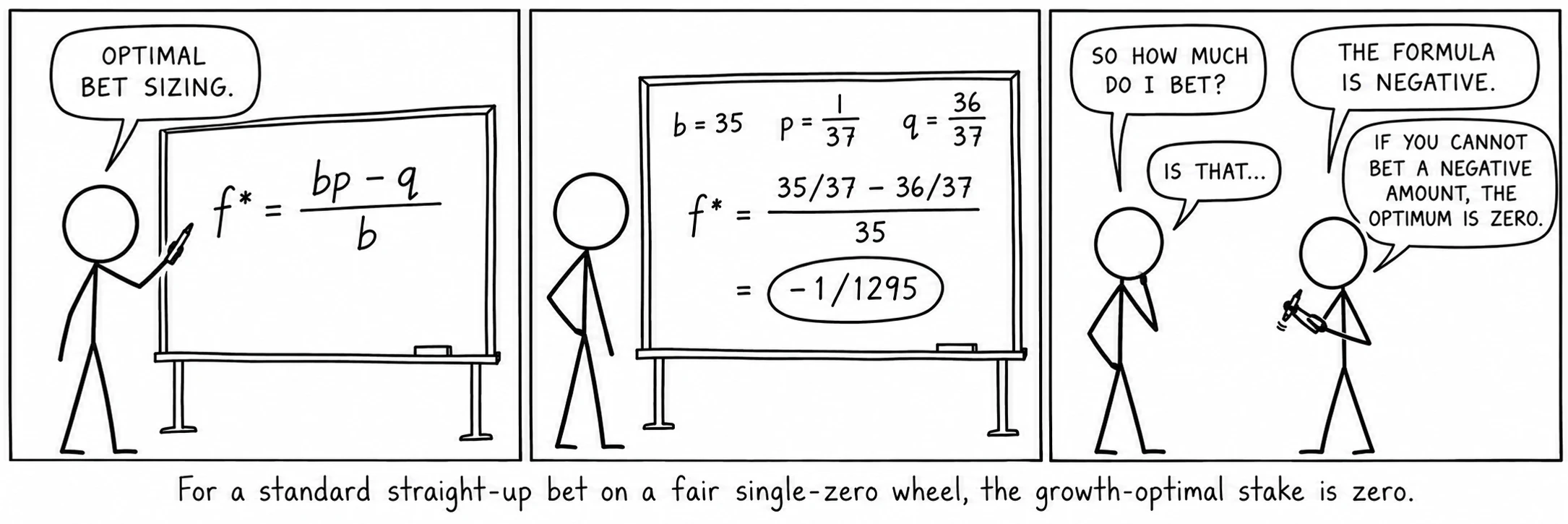
Amahera y'itego meza kuruta ayandi mu gukuza muri ruleti ni igitigiri abantu bose basanzwe bazi.
Aho Twakuye
- Kelly, J. L. “A new interpretation of information rate.”
- Breiman, L. “Optimal gambling systems for favorable games.”
- Thorp, E. O. “Optimal gambling systems for favorable games.”
- Thorp, E. O. The Mathematics of Gambling.
- Epstein, R. A. The Theory of Gambling and Statistical Logic, 2nd ed.
- Taylor, D. G. Games, Gambling, and Probability: An Introduction to Mathematics, 2nd ed.
- Ethier, S. N. The Doctrine of Chances: Probabilistic Aspects of Gambling.
- Haghani, V. & Dewey, R. “Rational decision-making under uncertainty: observed betting patterns on a biased coin.”