Kahise k'Uburyo bwo Gutega muri Ruleti
Ibinjana bibiri abantu bandika amategeko yo guhindura amahera y'itego ryabo.
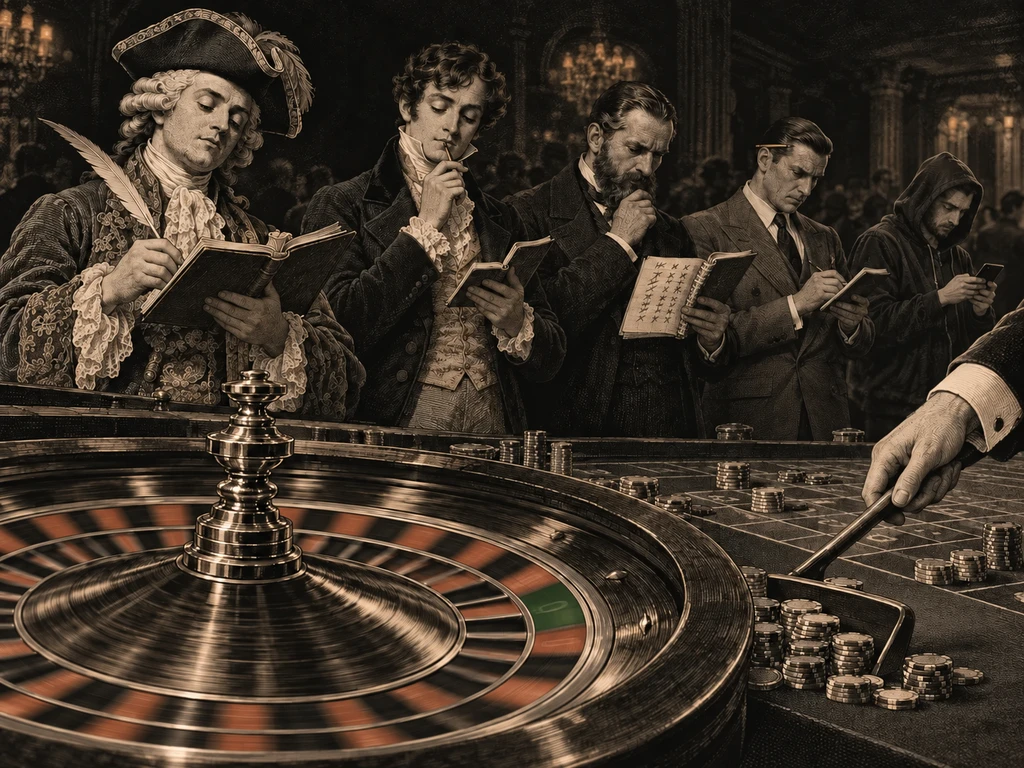
Martingale ni iyo mu kinjana ca 18; D’Alembert yitiriwe umuhanga mu mibare atabukunda; Labouchère ni ikinezereza c'umunyapolitike wo mu gihe ca Victoria. Na kimwe muri ivyo nticakora no muri ico gihe.
Martingale
The 1762 Académie française dictionary records martingaleingendo yo gutegaMartingaleIyongerekana rikuba kabiri itego inyuma y'igihombo cose. Raba igice c'Ingendo zo gutega umenye ivyo bukora n'ivyo budakora.Soma vyose → as a gambling term for staking what has been lost. Its 1878 edition explicitly describes doubling after a loss and also uses the word more broadly for betting schemes. These entries document usage; they do not identify a single inventor.
Today the familiar doubling progressioningendo yo gutegaIyongerekanaItegeko ryose rihindura amahera y'itego hisunzwe ivyavuyemwo vyabanje. Iyongerekana rihakana riyongereza inyuma y'ibihombo, iryemeza inyuma y'itsinzi.Soma vyose → aims to recover previous losses and gain one starting unitamaheraIgiceAmahera y'itego y'ishingiro uburyo canke umukinyi akoresha. Iyongerekana ridondorwa mu bice kugira ngo rikore ku meza ayo ari yo yose.Soma vyose → when a win arrives. A finite bankrollamaheraAmahera yo gukinishaAmahera yose yashizwe ku ruhande yo gukina. Gucunga amahera yo gukinisha ni uguhitamwo ayo ushobora gushira mu kaga kuri buri tego no kuri buri gihe c'ugukina.Soma vyose → or table limitamezaUrugero rw'amezaItego ritoya n'irinini kuruta ayandi vyemewe. Urugero rwo hejuru ni rwo ruhagarika iyongerekana rikuba kabiri.Soma vyose → can stop the sequence first. The Strategy section shows how those limits affect a session.
D’Alembert
The progression bearing d’Alembert’s name raises the stake by one unit after a loss and lowers it after a win. The name alone does not prove who devised or endorsed the betting rule.
Its mathematical issue is straightforward: on independent spinsimibareUkuzunguruka kwigengaUkuzunguruka kwose kugira ugushoboka kumwe n'ivyabaye kera vyose. Ni co gishingiro c'ibiharuro vyose vyo kuri uru rubuga.Soma vyose →, a run of one outcome does not make the opposite outcome due. A famous namesake does not change that assumption or the payoutamaheraIrihaIvyo itego ritsinze rizana, bivugwa nka “X kuri 1” hiyongereyeko amahera y'itego asubizwa.Soma vyose →.
Labouchère
The cancellation system uses a list of numbers to determine the next stake. A win removes entries and a loss adds an entry; the Strategy section sets out the rules and examples. Historical stories about its namesake should be distinguished from evidence that the method creates an advantage.
A sequence may clear with a profit, but a losing run can leave a growing list and larger required stakes. How often it clears depends on the starting list, bankroll, limits and stopping rule. There is no universal success percentage.
Ikinjana ca 20
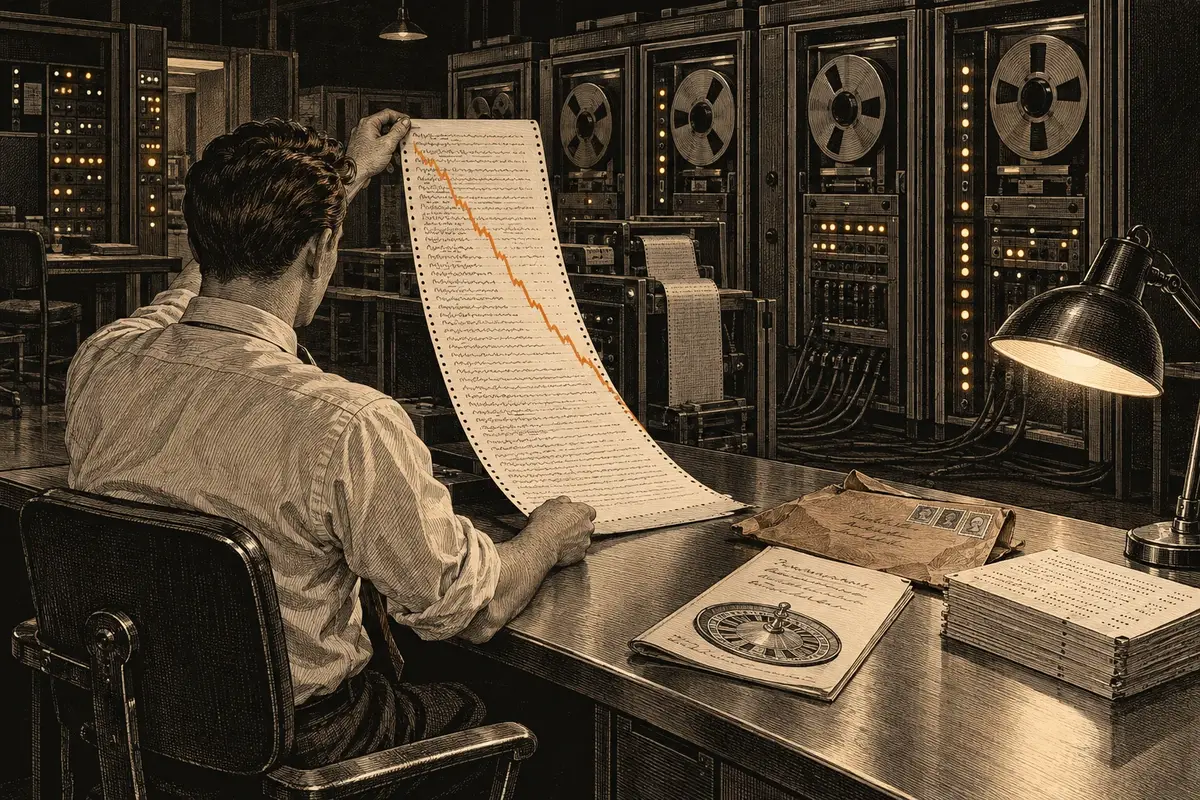
A simulation can show how a specified system behaves under a chosen wheel model. It cannot test every possible rule, and a finite run need not return exactly the theoretical house edgeimibareInyungu ya kazinoIgice c'amahera y'itego kazino igumana ku mpuzandengo: 2,70% muri ruleti y'i Buraya.Soma vyose →.
For independent uniform single-zerouruzigaZeruAkazu kamwe k'icatsi kibisi kadapfukwa n'itego rya rimwe kuri rimwe, ry'umurwi canke ry'inkingi; ni yo soko y'inyungu ya kazino. Kandi bita: zeru imwe, 0.Soma vyose → spins with standard full-loss-on-zero payouts, each unit staked has expected net return −1/37. For a bounded session whose stakes are chosen using information available before each spin, adding the conditional expectations gives expected lossimibareIgihombo citezweAgaciro kitezwe gakubwe n'amahera yose yateze; ni amahera y'impuzandengo atakara mu gihe c'ugukina canke mu gihe runaka.Soma vyose → equal to 1/37 of expected turnoveramaheraIgiteranyo c'amategoIgiteranyo c'amahera yose yateze mu gihe c'ugukina canke mu kiringo, harimwo n'ivyatsinzwe vyongeye gutegwa. Kandi bita: handle, action.Soma vyose →. Stopping or changing stakes can change the distribution of results, but not create positive expectation under those assumptions. Other payouts, such as la partageitegekoLa partageItegeko ry'Ubufaransa: iyo zeru ije, igice c'amahera y'itego rya rimwe kuri rimwe kirasubizwa. Rigabanya inyungu ya kazino kuri ayo matego gushika kuri 1,35%.Soma vyose →, need their own calculation.
Umugani: Ingendo yo Gutega muri Ruleti Itsinda Imisi YoseIngendo ya Fibonacci muri Ruleti
Igituma bugumaho
A demonstration can end in profit without showing that the method has an edge. Some rules favor frequent small wins at the cost of occasional large losses; others do the reverse. The proportions depend on the exact rules and limits.
When comparing systems, look at all completed sessions, total stakes, losses and stopping conditions. A selected winning example leaves out the information needed to assess the claim.
Uburyo bugurishwa
Systems have also been sold with elaborate names and entry rules. The examples below illustrate the arithmetic of specific rules; they are not evidence of who first invented or marketed them. Waiting for a pattern does not alter the next independent spin’s probabilities.
Ikitari uburyo
Amategeko yo guhagarara: guhitamwo imbere y'igihe ingene ushaka guhomba canke gutsinda hanyuma ukagenda. Kenshi agurishwa nk'igice c'uburyo kandi ni co gice conyene gikora ikintu, kuko agabanya igiteranyo c'amatego. Nta muntu yitiriwe, kandi ivyo birakwiye.
Ibibazo
Martingale, iburusha ikinjana canke birenga. Gukuba kabiri inyuma yo guhomba ni co ciyumviro ca mbere umuntu wese agira.
D’Alembert ni we yegereye ivyo, atabigambiriye. Pascal, Fermat, Huygens, Bernoulli na Laplace bose basiguye igituma buranka.
Kubera ko ibihe vyinshi vy'ugukina bitsinda, kandi videwo y'igihe c'ugukina catsinze ntihenda kuyikora.
Agakuru ko gutwenga
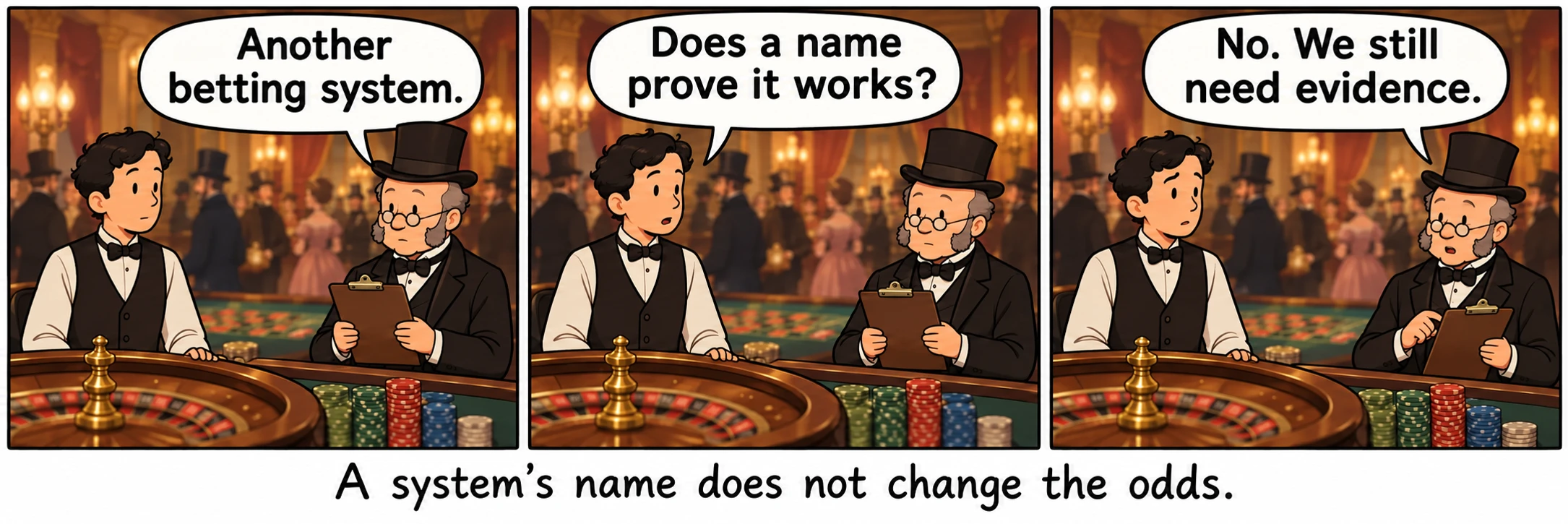
Ibinjana bibiri vy'amazina. Igitigiri kimwe.
Aho Twakuye
- Thorp, E. O. “Optimal gambling systems for favorable games.”
- Thorp, E. O. The Mathematics of Gambling.
- Doob, J. L. “Note on probability.”
- Halmos, P. R. “Invariants of certain stochastic transformations: the mathematical theory of gambling systems.”
- d’Alembert, J. “Croix ou pile.”
- Schwartz, D. G. Roll the Bones: The History of Gambling.
- Kavanagh, T. M. Dice, Cards, Wheels: A Different History of French Culture.
- Bollman, M. Mathematics of the Big Four Casino Table Games: Blackjack, Baccarat, Craps, & Roulette.
- Académie française, martingale, 1762
- Académie française, martingale, 1878